


All images ©Copyright: Earthy Photography®
Day 33 | 29 September 2025 | Walking the Camino Francés
From Molinaseca to Cacabelos | 21.1 km 13.1 miles
We left Molinaseca rather late at 07:00. After crossing a mountain yesterday, today’s walk promised to be mostly flat and, thankfully, free of flies. Nice.
Walking through the suburbs of Ponferrada, we noticed that a few of the villas had quirky little gnomes dotted around their front gardens. Back home in England, garden gnomes are like Marmite – you either love them or hate them. Personally, I’m partial to both.
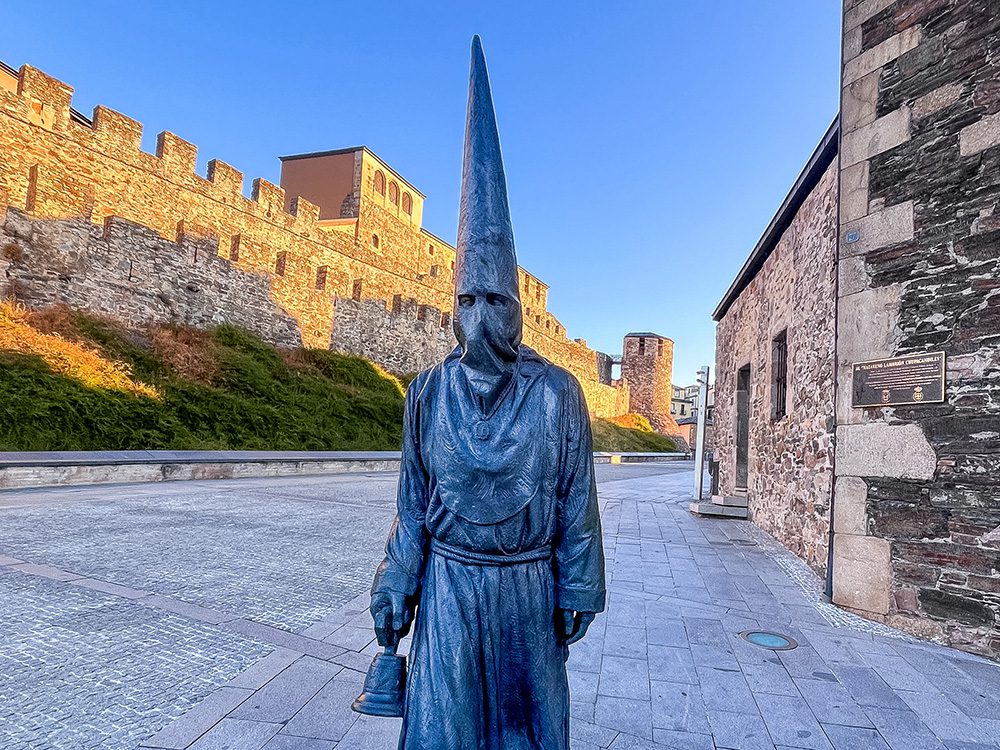
As we entered Ponferrada, we kept an eye out for somewhere to stop for breakfast. Turning a corner, we were instead confronted by a rather sinister-looking statue of a solitary figure …
A little research revealed it to be the statue of the Nazarene Lambrión Chupacandiles, located near the Templar Castle that is visible in the background. The figure represents a Nazarene from the Royal Brotherhood of Jesus of Nazareth.
Across Spain, the week leading up to Easter Sunday is marked by Semana Santa (Holy Week), a deeply rooted and visually striking tradition. It is a wonderful time to visit. More information can be found here: Semana Santa in Ponferrada | Semana Santa in Spain
Passing through the historic village of Columbrianos, we noticed that several albergues had colourful signs depicting pilgrims carrying traditional walking staffs, with gourds hanging from them. These dried gourds (pumpkins), with their hard outer shells, were once used by pilgrims for carrying water along the Camino.
In a forest on the approach to Cacabelos, we came across another enterprising local artist offering pilgrims sellos (stamps) in return for a donation. His stamps were particularly colourful and unusual, made using wax to create an intricate design. As I still had a space left in my pilgrim’s credential, I asked him to add one to my collection.
We reached our hotel in Cacabelos quite early, which was welcome – the temperature had already climbed to 26°C, and there had been very little shade along the way.
